From Crypto Highs to Cab Business Lows: One Nigerian’s Naira Life Story
In this week’s Naira Life, a Nigerian man recounts his financial journey from childhood snacks to crypto windfalls, a thriving cab business, and a devastating theft that upended his income. He now navigates life in Port Harcourt on roughly ₦100,000 a month, sharing his struggles and hopes.
Early Money Memories and First Earnings
Money mattered early for him, mainly for snacks. In primary school, he saved his daily allowance to buy meat pies for ₦50 or ice cream for ₦30. His parents gave him and his siblings snack money, though his older sisters received more. Growing up as the fifth of six children, his father worked at an oil company and ensured school fees were always paid on time. His mother worked in community health. While not wealthy, the family had necessities, including new Christmas clothes each year.
His first earning experience came in secondary school through video games. He played fighting games like Mortal Kombat and Dragon Ball at game centres, where people bet on his matches. He earned a percentage of wins and entered small tournaments, sometimes winning up to ₦1,000—a significant sum when an hour of gameplay cost ₦50.
After finishing secondary school in 2009, he spent two years awaiting university admission. During this time, he did basic computer training and learned safety procedures under an HSE officer who trained people for rig work and worked with companies like Shell. He marketed fire extinguisher refills to schools and hotels, earning around ₦50,000 monthly. The transport fare to his office was about ₦50, and he could even walk. With no real responsibilities, he spent most of the money on clothes, gadgets, and video games. He left in 2011 after gaining university admission and moved to another state.
University Side Hustles and NYSC

At university, he wasn’t a steady entrepreneur but seized opportunities. He bought graphic tees and resold them, sold Dashiki shirts on order from Port Harcourt, bought charm bracelets from Amazon, swapped updated video games for a fee, and sold downloaded PC games to hostel mates. However, he didn’t need much cash because his father was transferred to the same state and he lived with him close to campus. His father gave him ₦2,000 daily for transport plus pocket money, and he ate at home, so he had almost zero expenses.
He graduated in July 2015 and went for NYSC in Abuja. His Place of Primary Assignment was a government agency that paid a ₦5,000 stipend on top of the ₦19,800 federal allowance. His job involved compiling data on national issues from all 36 states and summarising reports sent directly to the President. He lived close to the office and walked to work, saving transport costs. Abuja impressed him with good roads, nice parks, and accessible malls.
After service, the agency couldn’t retain him due to lack of funds. In 2017, he returned to Port Harcourt and rejoined the safety firm where he had worked after secondary school. His salary rose to ₦100,000 monthly, with a promised office phone and laptop that never materialised. He stayed about five months, worked briefly at a fuel station his sister managed, and spent the rest of 2018 preparing for a master’s degree.
Master's Degree, Crypto, and Odd Jobs in Cyprus
His father, who deeply valued education, funded his master’s before passing away in 2018. He also secured a 50% scholarship. In January 2019, he left Nigeria for Cyprus. Shortly after arriving, friends introduced him to cryptocurrency. He bought one Ethereum coin for ₦80,000 (around $170–$200 at the time). When COVID hit in early 2020, the market crashed, and his Ethereum dipped to $114. Friends advised selling, but he held on. By 2021, the crypto market boomed, and his single Ethereum token rose to $4,000. When it fluctuated between $3,800 and $4,000, he converted it to USDT to lock in the profit.
He didn’t spend the crypto; instead, he took odd jobs. He worked on a bee farm where the owner paid 300 Turkish Lira (TL) a day, provided meals, and gave fresh honey. Normal odd jobs paid around 60–80 TL per day for hard labour. He also cleared farms, moved restaurant equipment, and chopped firewood for an elderly neighbour who paid 50 TL for 20 minutes of work.
Before leaving Nigeria, his family made a joint investment of ₦10 million into a bitumen company, with each contributing about ₦2 million. His share came from what his father left him. The investment returned $300 monthly. But during COVID, financial policies shifted, the dollar skyrocketed, and payouts froze. Fortunately, living costs in Cyprus were low; the TL equivalent of ₦10,000 could last a week. He also had leftover funds from his father’s master’s money. He completed his degree in 2021.
Failed Move to Australia and the Cab Business
He tried to move to Australia on a work visa. An agent asked them to come to Nigeria for biometrics, so he and his roommate flew to Lagos and paid over ₦300,000. Then the agent gave endless excuses, and by then, their Cyprus student visas had expired, so they couldn’t return. In 2022, after months of staying at home, he withdrew ₦1.55 million from his crypto profits (almost the entire amount) and bought a car to run an e-hailing cab service.
Initially, he made over ₦20,000 daily after covering fuel. Over time, he built a network of private offline clients. He picked up remote call-centre workers between 9 p.m. and 11 p.m., did airport drops for ₦20,000, and handled inter-state trips. By 2023, fuel and maintenance prices had skyrocketed. Engine oil went from ₦6,000 to ₦14,000. Nigerian roads caused heavy wear and tear, and he was constantly fixing something. He decided full-time driving didn’t make financial sense, so he cut back hours and focused on private clients. Daily income dropped to around ₦15,000, but he was still comfortable.
He ran the e-hailing business until February 2025, when his car was stolen. He had parked near a church to answer a call about a driving gig, leaving the car behind some school buses. When he returned, the car was gone. His tracking subscription had expired, so he couldn’t trace it. That car was his business and main income source, so losing it was a huge blow. Still, he joined friends for karaoke that same Sunday evening. “Sundays were my only time off and my only opportunity to hang out with my friends,” he explains. “That day just turned out to be an unfortunate Sunday.”
Later, a friend who worked at the church reported the theft to management. They involved the police, but nothing came of it. A few weeks later, around the end of March, the head pastor gave him ₦1 million as support. He spent most of it trying to fix a family Sienna car to work with, but it’s now parked at a mechanic shop with gearbox issues.
Government Job Attempt and YouTube Gaming
Around the time his car was stolen, his uncle called about a potential government job in another state. He spent five months living with his sister there, but the job didn’t work out, so he returned to Port Harcourt in August 2025. Back home, he focused on building a faceless YouTube gaming channel. He had always been a gamer and thought he could earn from it.
It took a while to hit 1,000 subscribers, but when he did and qualified for monetisation two months ago, he faced multiple ID verification issues. He eventually linked a friend’s AdSense account to get approved. Recently, the post office called him to pick up his physical Google AdSense code. But the exact day he brought the code home, his laptop battery died. The battery model isn’t available in Nigeria, so the code remains unread, and his $62 channel earnings are stuck until he gets a working PC.
Current Income and Monthly Expenses
Now, he assists his sister by marketing her organic cosmetics and supplements on social media for a commission, earning around ₦10,000 or more per month. He also clips music on another YouTube channel, which earns about $60–$80 (approximately ₦90,000) monthly after taxes, alongside occasional side gigs. For instance, he recently helped administer online exams for an institution. “I just do whatever brings money,” he says.
He has applied for various opportunities, but jobs in Nigeria are time-consuming and pay poorly. Recently, he applied for remote call-centre expert roles with foreign companies but didn’t get the job because they wanted someone with an upbeat American accent and tone, which he doesn’t have. “With many remote jobs, once you state you are Nigerian, it becomes much harder to get hired, even if you’re qualified,” he notes. He’s also looking into AI video making and animation. “People recommend AI, but no one talks about the expensive subscription plans. If your prompts fail, your money goes down the drain.” Still, he wants to learn it because he can already generate AI voices and images, and wants to master video creation next. Currently, his monthly income sits around ₦100,000.
Living in Port Harcourt is expensive. He’s on Band A electricity, where ₦1,000 only gives 4 units of power. So, in a week, electricity can cost around ₦15,000—about ₦60,000 per month just for power. He lives with a friend and they share expenses, but his friend contributes more. His share of monthly expenses includes: Power: ₦30,000; Internet: ₦10,000 (his share of a three-way MTN Fibre split with their neighbour); Food: varies, but takes up the bulk of remaining funds. His flatmate contributes more to food. Their rent jumped from ₦800,000 to ₦2.2 million last year, so his share is now ₦1.1 million. “Mad,” he says. “I thought they only did that in Lagos.”
Safety Net, Money Relationship, and Future Goals
His safety net is down to about ₦2 million. Half is from cryptocurrency he’s invested in over the years, and the other half is savings from his cab earnings. With his laptop broken and rent coming soon, this cushion will shrink again, which worries him. “I’m just trying to get back on my feet,” he says.
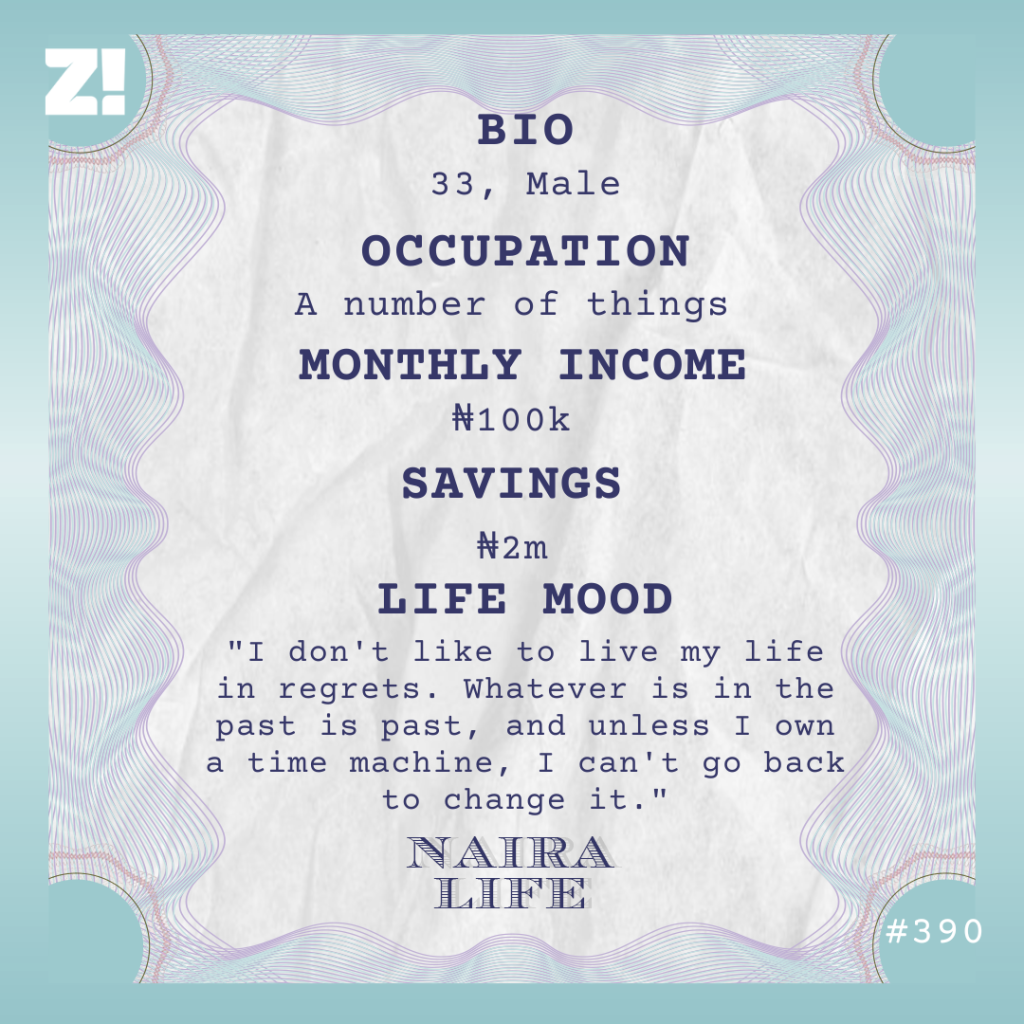
He describes his relationship with money as toxic. “When I have money, unexpected issues pop up, or I spend on wants because I can afford them. But my current financial state has forced me to prioritise needs over luxury.” He has no money regrets. “I don’t like to live my life in regrets. Whatever is in the past is past, and unless I own a time machine, I can’t go back to change it. What if going back in time to change something caused me to die, and I wouldn’t be here to give you this story? As long as I’m here right now, I still have a story to write. Whatever will be, will be.”
He believes an ideal monthly income would be ₦1 million. “It’s a realistic target if my hard work pays off.” Right now, he wants a high-performance laptop for video editing and AI content creation, like an HP Onyx (around ₦750,000) or an Alienware (around ₦1 million). If his car hadn’t been stolen, he thinks he’d still be driving private clients at night and growing his YouTube channel during the day. “At least, I’d be earning enough from driving to sponsor YouTube content creation.”
He rates his financial happiness 2 out of 10. “Going from having $4,000 in crypto and an active daily cash flow to where I am today is a massive drop. Losing my car set me back significantly, but I haven’t gone all the way back to level zero. It’s like playing a game where your data gets corrupted; instead of dropping from level seven to level zero, an auto-save brings you back to level four. It’s just a setback, and if I get the right equipment and opportunities, I know how to get back up there.”
Comments are closed.