From Deeper Life to Scotland: One Nigerian Woman’s Story of Faith, Adaptation, and a Master’s Degree
Pelumi was 25 when she left Nigeria in September 2021 to pursue a master’s degree in Human Resource Management at the University of Stirling in Scotland. Her journey was not something she had always planned. In fact, she had never intended to travel abroad at all.
After completing her Higher National Diploma (HND), Pelumi felt that an HND alone was not enough. She wanted academic advancement and was exploring conversion programmes in Nigeria when her brother encouraged her to apply for a master’s in the UK. She applied to multiple universities and received about six rejections before the University of Stirling offered her admission.
Her family was overjoyed. “They were really proud of me and happy that I was going for my master’s,” she recalls. Though she had moments of doubt, she had prayed about the decision and felt confident it was the right path. “On the night I was leaving, I was worried because I was only 25 and travelling to a new country alone,” she says. “But I knew that if God was taking me there, He would sort everything out for me.”
Pelumi received a 20% scholarship, and her family funded the rest. She had just finished her national service and was not working, so self-funding was not an option.
Applying for a Master's with an HND
One of the most unusual aspects of Pelumi’s story is that she applied for her master’s using her HND. She explains that this is possible if you have a Distinction or strong Upper Credit, a good Cumulative Grade Point Average (CGPA), and a strong personal statement. It also helps if the master’s course is relevant to the course studied during the HND.
Her educational journey was far from straightforward. While her sister attended Obafemi Awolowo University (OAU) and her brother went to the University of Abuja, Pelumi was the only one who attended a polytechnic. She became the first person in her family to earn a master’s degree.
After her National Diploma (ND), she finished with a 4.0 and was the second-best student in her department. She tried to use direct entry to study Public Administration but was not admitted. She returned for her HND, finished well, and tried direct entry again, but still was not given admission. Eventually, she decided to focus on her HND and look for other opportunities, including conversion programmes. The UK master’s opportunity came later.
“When I eventually graduated, it meant a lot to me because I knew everything I had gone through to get there,” she says. “It was a journey of perseverance and not giving up.”
Arriving in the UK: Challenges and Adjustments
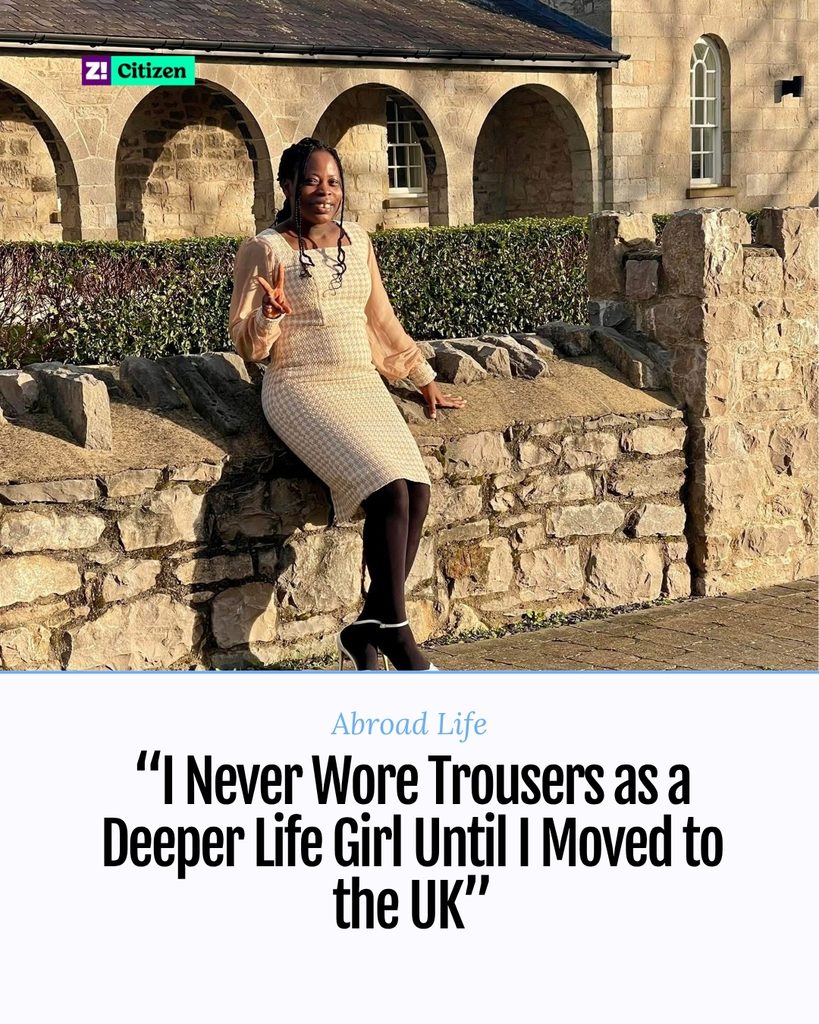
Landing in the UK brought mixed feelings. Pelumi was happy to finally be there, but she faced numerous challenges. The first was dressing. As a Deeper Life church girl, she had never worn trousers in her life. Arriving during winter made this particularly difficult. “I remember one day I went out and eventually had to take a taxi back home because I was struggling with the cold,” she says.
For about six months, she tried to stay true to herself by wearing leggings underneath her gown or skirt. Eventually, she began wearing trousers, convinced that there was nothing wrong with it. “For me, it became a matter of personal conviction,” she explains. “I still believe people should dress modestly and not expose their bodies, but I also believe everything should be done in moderation.”
Her church in the UK had no problem with the change. She still attends Deeper Life church in the UK, now with her husband and children. She believes the environment plays a role, as the UK is different from Nigeria. She has discussed this topic extensively on Facebook, where people have shared various opinions. “If you’re a Christian, you have the Holy Spirit, and you should be able to know what is right for you,” she says.
Navigation was another major challenge. In Nigeria, she rarely used Google Maps, but in the UK she had to learn quickly. The first time she went to work, she ended up in a completely different place and had to go back home. Food was also an issue. At the time, there were not as many African shops as there are now, and as a student with limited funds, she could not afford to ship food from Nigeria. She had to start eating Scottish food.
Differences in the Education System
The education system in the UK was quite different from what Pelumi was used to in Nigeria. Almost everything was done online. Assignments, tests, and quizzes were all submitted and completed on a laptop. “If you’re someone who doesn’t know how to use a laptop or find your way around one, you could struggle a lot,” she notes. She did not struggle too much, but it was still challenging at times.
The biggest challenge came towards the end of her studies when she had to retake her research module. In the UK, when you fail a module, you can be asked to resubmit it one more time. Pelumi got 40 at first, then resubmitted and got 44. She received an email informing her that she had failed the module again and that her points were no longer enough for her master’s degree.
At that point, she had two options: retake the course the following year or accept a postgraduate certificate instead. If the points for a master’s is 170 and you got 140, the university will advise you to collect a certificate instead if you do not want to retake the course. It was a difficult decision because it would also affect her visa. Retaking the course meant extending her student visa and undergoing the entire process again.
Personally, it was a lot to handle. She was already married and pregnant at the time. “I remember being very discouraged,” she says. “I told my brother I couldn’t do it and that I would just collect the postgraduate certificate.” Many people told her they could not be bothered with the stress and would rather accept the certificate. But her family encouraged her to look at how far she had come and apply for the extension so she could retake the course.
She applied and received a six-month extension on her student visa. She had to get a new letter from the school and apply for another visa. She retook the module and, when she was about to submit her work, she prayed because she knew it was her final chance. “I kept telling God that if I failed again, that would be the end,” she recalls. Thankfully, she got 55 and was able to graduate the following year. She did not graduate with her mates, but she survived it. “It was the biggest challenge of my life,” she says.
Financial and Emotional Support During Studies
As a student, Pelumi could work 20 hours a week, which she did. It was not easy working while attending classes and doing assignments. Her family paid her school fees, so she mainly had to cover her accommodation, food, and other small expenses. That gave her some room to work and support herself.
Emotionally, her family and the community she joined in the UK were very helpful. Her most memorable experience at university was her graduation day. “I cried so much because I was just so happy that, after everything, I was finally able to graduate,” she says. She also had a positive experience at Stirling generally. She never experienced any racism there, and the lecturers were always very nice and polite to her.
Life After Graduation
By the time Pelumi graduated, she was already married and had just had her baby. She is now mainly focused on her family. She has a blog, creates content, writes online, and works part-time because she has two kids and cannot work full-time at the moment.
She met her husband in Nigeria. Their story is unusual: they knew each other in Nigeria but were not friends. They had mutual friends and attended the same secondary school, although Pelumi left after JSS and went to Government College. They reconnected online and started a relationship. She came back to Nigeria for their wedding in March 2023. He was still in Nigeria at the time, so after the wedding, he applied for his visa and joined her in the UK two months later. “A lot of people told me I was crazy and that I didn’t know what I was doing,” she says. “But I thank God I’m not crazy.”
Life as a Nigerian family in Scotland has been good. “You just have to adjust,” she says. Since she lives in Scotland and does not have plans to relocate back anytime soon, she has to adjust to the way things are done there. She follows the rules and regulations and does things the right way. Raising children there also means understanding what is acceptable and what is not. “There are things that people might consider normal in Nigeria that are taken very seriously here,” she notes.
For her, the key is setting priorities right, surrounding herself with people who genuinely encourage her, and having a good community. Her church in Glasgow has helped her a lot. Even when she was having issues at school, they encouraged and supported her. “Having the right community is very important,” she says. “And for me, there is also the God factor. I don’t think you can raise a family without God. It’s a major part of my life.”
Culture Shock and Observations
Pelumi’s biggest culture shock in the UK was the politeness. She noticed that people say thank you to bus drivers. “I was like, ‘Are they not doing their work? Are they not collecting money?'” she recalls. But when you get off the bus, you say thank you. Adults say it. Children say it. People are also very respectful in the way they speak to one another. Even if a lecturer is talking to you, there is a certain level of respect. Giving people respect is a big deal there.
She wishes Nigeria could adopt the UK’s approach to law enforcement and the implementation of rules. In Nigeria, rules can be made, but implementing them is often the problem. In the UK, they investigate things properly before making decisions, and people generally follow the rules. Even something as simple as crossing the road is different. You wait for the traffic light to turn green before crossing. People queue without needing security or police officers to tell them to line up. Driving is another example. Her friend recently told her she was taking her practical driving test for the fifth time. Some people do not pass until their tenth attempt. “It is not easy, but once you pass, you know you have to follow the rules when you drive,” she says. “Everything is just orderly. People follow the rules and regulations, and I think that is something that could help Nigeria.”
Future Plans and Advice for HND Holders
Pelumi clarifies that she never said she does not have plans to return to Nigeria. She said that since she is living in the UK, she does not have plans to relocate back anytime soon. “If, in the next 10 years, God tells me to go back, I’ll pack my bags and go,” she says. “My life is based on what God tells me to do. Whether I’m in Canada or Nigeria, I believe God’s blessing will reach me.”
She believes God is the ultimate planner. When she was preparing to travel, she had other plans. She had already gotten admission to Cotonou in Benin to study for a BSc and had started before she got the master’s admission in the UK. If she had not gotten the UK admission, she would still have been doing great things for herself in Benin or Nigeria.
She chose the UK master’s over continuing with the BSc in Cotonou because getting a master’s with an HND was a big deal to her. She had tried several times to get admission through direct entry for a BSc but was not given admission. Even when she finished her ND with a 4.0 and was one of the best students in her department, she could not get the direct-entry admission she wanted. Someone she encouraged to apply had a lower grade and got admission, but she did not. So she returned to the polytechnic for her HND and made sure she finished well. She also tried direct entry again during her HND and still was not given admission. Eventually, she decided to focus on finishing her HND well and looking for other opportunities. She applied for conversion programmes in different places and even got admission somewhere in Nigeria. She had started making payments and preparing to go before she eventually got the UK admission.
To Nigerians with HNDs who feel limited by their qualifications, Pelumi says: “Don’t limit yourself. If you finish with a good grade, whether distinction or upper credit, build yourself. Attend conferences, go to meetings, network, and look for opportunities. There are many opportunities out there. Even if you don’t want to get a BSc or postgraduate degree, you can still do great things with an HND.” She knows people who have done amazing things with their HNDs. One woman she knows studied at a polytechnic in Lagos and later travelled abroad. She recently got her BSc in Cyprus, but even before that, she had already achieved a lot. “So I encourage people not to limit themselves,” she says.
Pelumi still keeps in touch with a few friends in Nigeria, though many of her friends are now in the UK too. She is a busy woman, working part-time, running a blog, creating content, writing on Facebook, and raising two children. She does not have as much time as she used to, but she still chats with a few friends in Nigeria.
She rates her experience in the UK so far as eight out of ten. “The UK has generally been nice to my family and me,” she says. “I have a good community here; people are generally nice, and things work better here.”
Comments are closed.